Choosing dining room furniture is not simply a style decision. It is a daily test of strength, comfort, maintenance, and personal taste.
So, what is the best material for dining room furniture? Solid hardwood remains a dependable choice for many homes. Oak, walnut, and maple can handle repeated meals, chair movement, and occasional spills. Their grain also adds warmth beneath dining lights. With proper care, a wooden table may develop a richer surface over time. However, wood can scratch, absorb moisture, and react to changing humidity. It is durable, but not careless-proof.
George Nelson, an influential American furniture designer, observed, “Everything is designed. Few things are designed well.” His reminder fits this decision. A beautiful material can still fail when its construction is weak. Check the table’s joints, finish, edge thickness, and weight. Sit in the chairs before buying them. Notice whether the seat presses against your legs. Small details become obvious during a long family dinner.
Glass creates a lighter visual effect. It can make a compact room feel more open. Yet fingerprints appear quickly, and sharp corners may feel unsuitable for young children. Metal offers a clean, modern character, but some surfaces feel cold. Engineered wood can lower costs, though quality varies widely. There is no perfect answer.
The most suitable material depends on your room, household, budget, and maintenance habits. A busy family may prefer sealed hardwood. A formal dining space may suit walnut or stone. The honest choice is rarely the most fashionable one. It is the material you can live with comfortably for years.
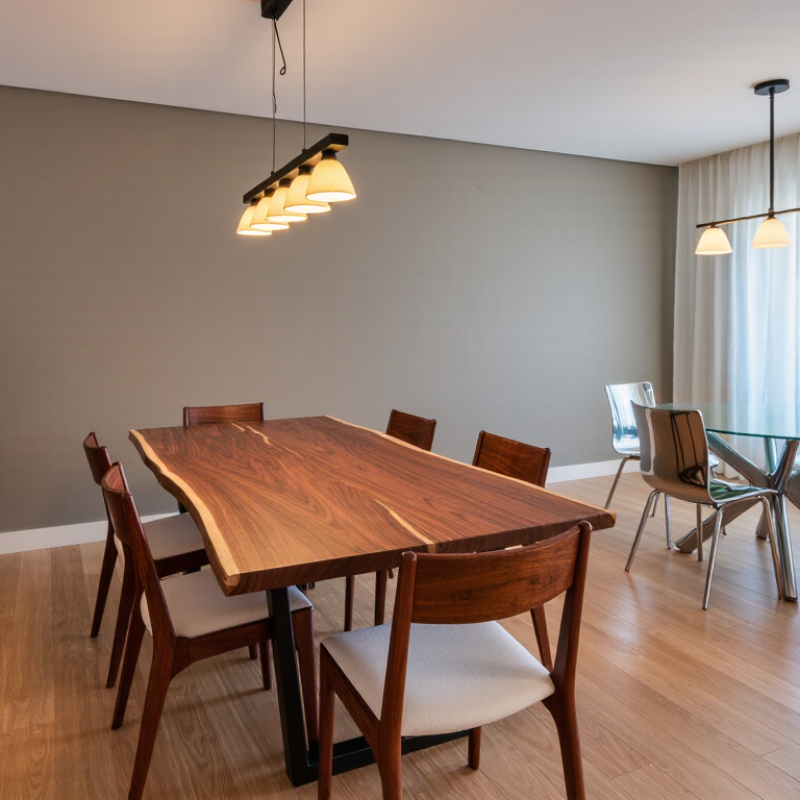
What Is the Best Material for Dining Room Furniture?
Define “Best” Through Durability, Safety, Cost, and Life-Cycle Data
“Best” depends on how a dining room is used. A busy family table needs strong joints, stain resistance, and easy repairs. Solid hardwood can be refinished after years of scratches. High-quality engineered wood may offer better dimensional stability in humid rooms. Ceramic or stone surfaces resist heat, but they can chip at exposed corners. Glass looks light and clean, yet fingerprints and impact risks require daily attention. Material choice should match real household behavior, not showroom appearance.
Safety includes more than structural strength. Look for stable construction, rounded edges, secure bases, and finishes with tested low emissions. Formaldehyde emissions from composite panels should meet applicable indoor-air standards. A sealed surface also reduces moisture absorption and cleaning chemical exposure. Cost needs two measurements: the purchase price and the ownership price. A low-cost table may need replacement after several moves, while a repairable table can remain useful longer. Still, expensive materials are not automatically safer or more durable.
Life-cycle data should cover raw materials, manufacturing, transport, maintenance, repair, and disposal. Reclaimed wood may reduce material demand, but its history and treatment require verification. Stone can last decades, although extraction and transportation may increase its environmental burden. This comparison remains imperfect because public data often use different boundaries. A practical assessment records expected service life, repair options, finish renewal, and local recycling access. My scoring may change after measuring actual wear in the home.
Solid wood is a strong candidate for dining room furniture, but moisture content deserves careful attention. The Architectural Woodwork Institute identifies 6–8% moisture content as a practical range for many interior wood applications. This target helps limit shrinking, swelling, open joints, and uneven tabletop surfaces.
The USDA Forest Products Laboratory’s Wood Handbook, FPL-GTR-282, explains that wood continually exchanges moisture with surrounding air. Indoor humidity changes can therefore move a tabletop outside its original range. A board at 7% moisture content may perform well in a controlled home. It may react differently beside a radiator or in a damp dining area.
The range is useful, not magical. Species, board thickness, grain direction, and regional climate all matter. A furniture inspector should measure several points with a calibrated moisture meter. Check the underside, edges, and areas near joinery. One reading is not enough.
In practical workshops, acclimation is often overlooked. Solid wood should rest in its intended indoor environment before final assembly. The USDA data supports this caution because equilibrium moisture content depends on temperature and relative humidity. A beautiful table can still develop a hairline gap. That does not always mean poor construction. Sometimes the room changed faster than the wood could respond.
For buyers, ask how the lumber was dried, stored, and measured. Request the recorded moisture range. Then inspect the finish and joinery closely. A reliable maker should explain these details without vague promises.
What Is the Best Material for Dining Room Furniture?
Engineered wood can be a practical choice for dining furniture. It offers stable surfaces and consistent dimensions. However, its quality depends on the panels, adhesives, and manufacturing controls. For furniture sold or used in California, verify CARB Phase 2 formaldehyde compliance. This standard limits emissions from composite wood products, including particleboard, medium-density fiberboard, and hardwood plywood.
Ask the seller for compliance documentation, not only a general safety statement. Look for the panel type, testing information, manufacturer details, and applicable certification records. Check whether the documentation covers the finished furniture, not just raw boards. Sealed edges and smooth laminate surfaces can reduce exposure, but they do not replace verified compliance. A strong chemical smell is not a dependable test. I once assumed odor alone indicated poor quality. That shortcut was careless.
Examine the table closely before buying. Inspect unfinished edges, drilled holes, and areas beneath the tabletop. These details may reveal how carefully the panels were sealed. Ask where the engineered wood was manufactured and whether production batches are tested consistently. Keep invoices and compliance records for future reference. Requirements can differ by location, so confirm local rules when importing or reselling furniture. CARB Phase 2 is a useful benchmark, but it should not become the only purchasing question. Durability, moisture resistance, joinery, and responsible sourcing also affect long-term value.
Metal can be an excellent choice for dining room furniture, but strength and corrosion resistance require separate checks. ANSI/BIFMA seating standards use demanding load and durability tests. For example, applicable chair protocols may apply a 275-pound, or 125-kilogram, test load and repeat loading cycles up to 100,000 times. These figures reflect practical risks: a person dropping into a chair, leaning back, or shifting weight across one leg.
ISO 9227 measures corrosion performance through salt-spray exposure. Neutral salt spray commonly uses a 5% sodium chloride solution at approximately 35°C. However, ISO 9227 does not set one universal pass-or-fail period. The product specification must define exposure time and acceptable rust, blistering, or coating loss. That detail matters. A supplier may report 240 hours of testing, yet the result remains incomplete without coating thickness, pretreatment, and inspection criteria.
In a real dining room, I would compare both records, not select metal by appearance alone. BIFMA evidence shows whether the frame survives repeated human loading. ISO 9227 evidence shows how the finish reacts to salty moisture. Different questions. Stainless steel can perform well near kitchens, while coated carbon steel may need careful edge sealing. Small scratches around screw holes deserve attention. They often become early corrosion points. I would also request test reports from an accredited laboratory, because an internal report can be useful but less independent. A strong load result does not guarantee long service outdoors or beside a humid dishwasher. That assumption needs challenging.
Glass and stone can both suit dining furniture, but appearance alone cannot predict durability. ASTM-based testing offers a more reliable comparison. Ask for the exact test method, specimen thickness, surface finish, and acceptance limit. Without those details, “tested” means very little.
For glass, impact evaluation should identify the dropped object, impact height, support conditions, and failure pattern. A tabletop that survives one controlled impact may still chip at an exposed corner. Tempered or laminated construction can improve safety, but edge design remains critical. Scratch testing should record the applied load, tool type, and visible damage under normal lighting. Tiny marks may disappear in a showroom.
Stone needs a different reading. Impact resistance depends on thickness, support, pores, veins, and edge profiling. Scratch testing should reflect contact with cutlery, ceramics, and grit carried by plates. Stain testing should list the agents, exposure time, cleaning method, and final rating.
Coffee, oil, wine, and acidic foods can reveal weaknesses quickly. In practice, a low stain score may matter more than a dramatic impact result. Dining tables face spills every day.
Not every ASTM procedure mirrors home use perfectly, so sample testing deserves attention before purchase.
It provides stable surfaces and consistent dimensions. Its quality depends on panels, adhesives, and manufacturing controls.
Request California Phase 2 formaldehyde compliance records. Check panel type, testing details, manufacturer information, and certification coverage.
Yes. Records covering only raw boards may not describe the completed table or chair.
No. Odor is unreliable. I once trusted smell alone, and that shortcut was careless.
Check unfinished edges, drilled holes, and the underside. These areas can reveal weak sealing or inconsistent production.
Consider durability, moisture resistance, joinery, and responsible sourcing. One certificate cannot answer every purchasing question.
Review applicable seating load tests and repeated-cycle results. Some protocols use a 275-pound, or 125-kilogram, load.
It indicates whether a frame tolerates actions like dropping into a chair or leaning backward.
It evaluates corrosion behavior under salty moisture. Testing commonly uses 5% sodium chloride near 35°C.
No. Ask for coating thickness, pretreatment, exposure time, and rust or blistering criteria. Details matter.
What is the best material for dining room furniture? The answer depends on how “best” is defined, including durability, safety, cost, maintenance, and life-cycle performance. Solid wood can provide long-term strength and repairability, but buyers should confirm that it has been properly dried within the industry’s typical 6–8% moisture-content range to reduce warping and cracking. Engineered wood may offer consistent construction and lower costs, provided it meets CARB Phase 2 formaldehyde-emission requirements.
Metal is another durable option, and its quality can be assessed through BIFMA load-testing information and ISO 9227 corrosion-test results. Glass and stone offer distinctive appearances, but their suitability depends on resistance to impact, scratches, and stains, which can be evaluated using relevant ASTM criteria. Ultimately, the ideal choice balances structural performance, indoor safety, appearance, maintenance needs, budget, and expected service life rather than relying on material type alone.

Living Land Furniture